Between Two Needles
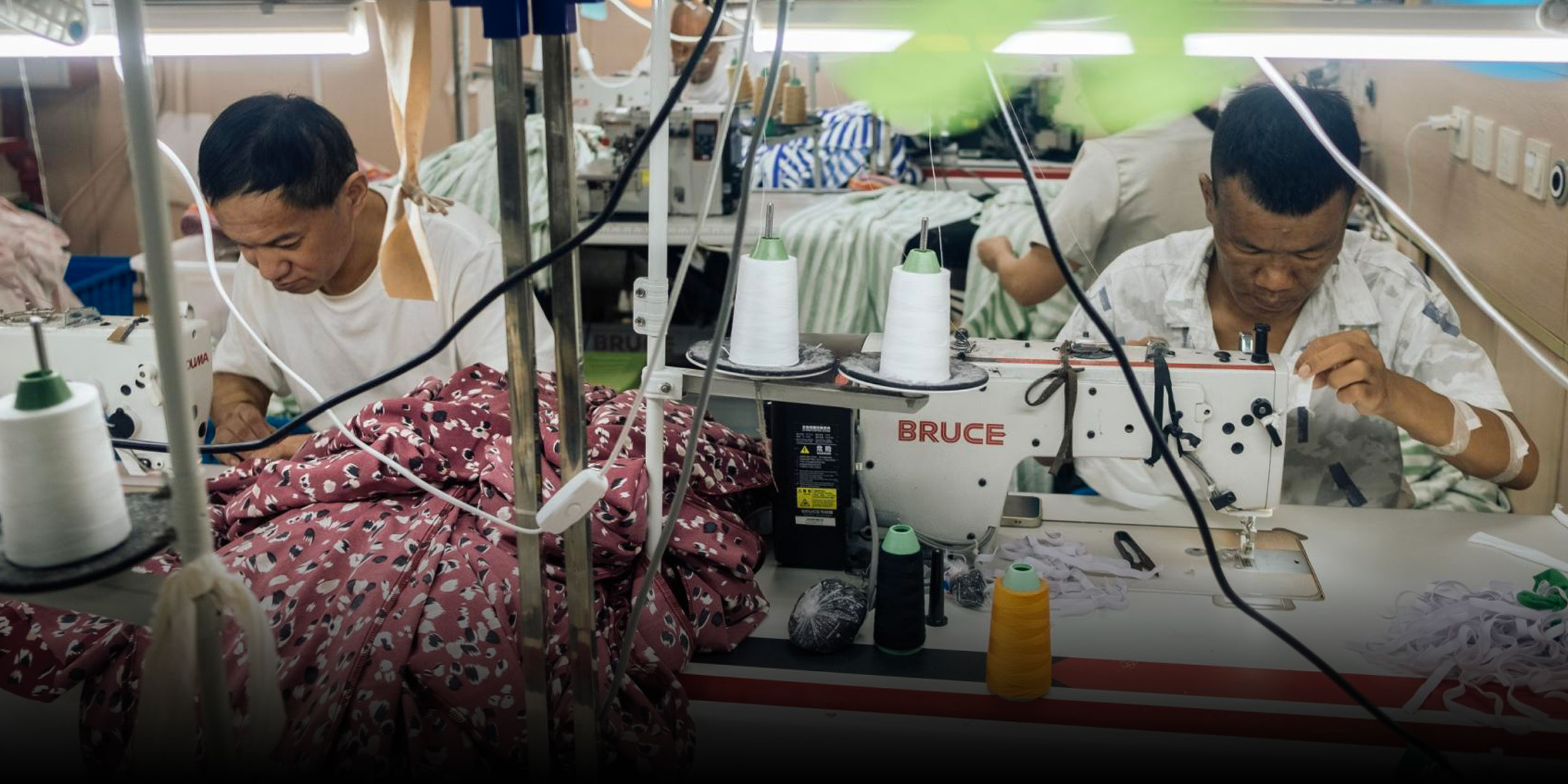
GUANGDONG, South China — The chef sits behind a sewing machine. The tunnel-boring machine technician hunches over an ironing board. The truck driver trims loose threads. And the stack of pink-striped crochet pants they’re making will end up in closets around the world.
Three times a week, they stop mid-stitch and descend to the dialysis rooms below, where nurses slide needles into arms darkened by repeated punctures, tape the lines in place, and watch the blood loop in and out.
Four hours later, they’re back upstairs, sewing. In Guangzhou, the capital of Guangdong province and one of southern China’s largest textile hubs, factories are built for efficiency. This one is built around survival.
Across China, more than 1.1 million people with kidney disease receive hemodialysis, a treatment that upends work, life, and travel. “Getting this disease feels like being abandoned by society,” says Li Shiqi, the chef. “Every day is dialysis, eating, sleeping, and waiting. It feels meaningless.”
Li is one of 67 dialysis patients working at Baoshutang Hemodialysis Center, where a garment factory operates upstairs. Most are migrant workers pushed out of previous jobs by renal disease. For many, it is their first stable work in years.
The center’s owner, Xie Qiang, a 58-year-old retired oncologist, opened the workshop in 2023. Patients work within reach of the machines that keep them alive; the clinic below receives steady income from their treatment.
“The factory is not just a place to give patients jobs,” Xie says. “What we really want is for dialysis patients to work again openly, without having to hide. It’s also a kind of training for their return to society.”
That return begins in a four-story building on the edge of Tianhe, one of Guangzhou’s busiest districts.
Kidney friends
Baoshutang gives passersby little reason to look past the clinic. Faded signs point only to the “Hemodialysis Center” on the second and third floors.
The garment workshop sits one floor above.
Like most workers here, Li found the factory through clips on Douyin, China’s version of TikTok. Just over a month in, he is already wondering if he made the right decision.
The monthly pay, 2,000 to 4,000 yuan ($300 to $600), was acceptable. But workdays often ran from 8:30 a.m. to 9:30 p.m., seven days a week, with only Sunday evenings off. To keep each station staffed, dialysis is arranged in morning, afternoon, and evening shifts.
Many workers stay in factory-paid dorms in the urban villages near Baoshutang. They sleep in 10-square-meter rooms with bunk beds shared by co-workers, among tightly packed blocks known as “handshake buildings.”
“I rushed into it,” the 35-year-old says. “I should have thought harder before coming. The work here is squeezing the last bit of labor out of me.”
His loud voice carries naturally across the workshop as he feeds fabric beneath the sewing machine needle without looking up. As the machine rattles, a raised blood vessel in his left forearm trembles under the skin — part of an arteriovenous fistula, a surgically created connection between an artery and a vein used for hemodialysis.
Like all dialysis patients, Li checks it every day, pressing his fingers against the spot to feel for a faint vibration. As long as it vibrates, dialysis can continue.
A trained chef, Li was diagnosed with end-stage kidney failure just months after his wedding. When he could no longer lift heavy woks or keep pace in the kitchen, his wife left, taking their savings with her.
“Honestly, I don’t even know what the point of being alive is anymore,” he says. “I’m not supporting my parents. I’m not raising children. So what am I living for?”
“You’re living for yourself,” another worker nearby says.
“But why should I keep myself alive?” Li asks.
“You’re not thinking of doing anything stupid, are you?” a third worker asks.
Li sighs. “It’s just … I’m not that ready to die.”
The workers fall silent. The sewing machines keep clacking. Dust from cut fabric hangs in the air.
Most workers here were diagnosed in their prime but could not afford a kidney transplant. Illness cost them marriages, jobs, and independence. Some say employers no longer want them because dialysis means repeated absences; others believe bosses are afraid they might die at work.
The treatment itself is no longer the largest expense. After medical insurance reimbursement, many patients pay only a few hundred yuan a month for dialysis. But complications can still empty their savings: blood clots, failed fistulas, infections, and the illnesses that follow.
“It’s like when one part of a machine breaks, the rest starts breaking too,” Li says.
Across from Li sits Chen Chunfeng, a worker nearly 20 years older. “Your mindset is wrong,” she calls out over the noise. “Don’t be so pessimistic.” She tells him to think of trees that have started to rot but still keep growing, sprouting, and slowly healing.
“Some things don’t heal,” Li says immediately. “I’m the villain here. I have no positive energy at all. Honestly, I hate the world.” Seconds later, he softens. “But I want to bloom too,” he says. “I want to bear fruit.”
He pauses. “I know I have issues with my mindset.”
Another worker tries to defuse the exchange. “It’s just because it’s raining,” the worker says. “That’s why he’s in a bad mood.” The workshop breaks into laughter.
But when Chen urges him again to stay positive, Li snaps.
“You don’t get to speak for dialysis patients,” he says. “You’ve never experienced this. Do you know what it’s like to finish dialysis and feel so hungry your heart races? Do you know what it’s like to be so exhausted you can’t move?”
Chen falls silent.
In the factory, dialysis marks a clear line. Patients call one another shenyou or “kidney friends.” Everyone else is a “normal person,” in the shorthand used inside the workshop. Even Chen, who has not yet reached end-stage failure, falls on the other side.
“They feel equal only when they’re among themselves,” says a longtime employee who is not on dialysis. “When they talk to people outside that group, many feel looked down on.”
Learning curve
Chen Chunfeng is still outside that group. For now.
From neighboring Hunan province, she was diagnosed with kidney disease after tumor surgery in 2017. She came to the factory in 2024, before dialysis became necessary, hoping the work would make the transition easier if that day arrived.
From her sewing station, she sees what that life looks like. During breaks, dialysis patients sip water carefully to avoid putting extra strain on their bodies. In summer, some suck on ice cubes or lemons to ease their thirst.
Protein powder and sugar sit in a shared cabinet to prevent cramps and low blood sugar after treatment. Pills for dialysis-related complications lay on communal dining tables beside chili sauce and pickled vegetables. In the corners, discarded boxes for dialysis supplies are stacked among the fabric and finished garments.
Chen quickly swallows a handful of green traditional Chinese medicine pills. “I’m trying to delay dialysis for as long as I can,” she says. The medication costs more than 1,000 yuan a month, more than many dialysis patients here pay for treatment.
A childhood machine accident left Chen with only the thumb and index finger on her right hand, and she found Baoshutang while searching online for work open to disabled, older, and dialysis patients.
Here, she hopes to make 200 yuan a day while she still can, gripping fabric with the two remaining digits on her right hand and guiding it with her left. Most dialysis patients at Baoshutang earn between 2,000 and 3,000 yuan a month; for Chen to reach her target, she must take more piecework, work overtime, and earn bonuses for training newcomers.
She worries that once dialysis begins, she will no longer earn enough to support her youngest son, who is in his second year of high school. “I don’t really have any other wishes,” she says. “I just want my child to have a better life.”
Tang Kai, a 46-year-old also from Hunan, previously installed tunnel-boring machines, but started out at the factory delivering finished garments. “Then I learned basic ironing, intermediate ironing, and final pressing,” he says. “It took me six months to learn them all.” He still has not learned to sew.
“To become a skilled sewing worker, you usually need at least two years of experience with different styles, fabrics, and processes,” Tang explains. “With only a short period of training, you can do only simple tasks, and it’s hard to meet customers’ quality requirements.”
The steep learning curve leaves many dialysis patients clustered in the lowest-skilled jobs while they learn.
“That’s why the factory is struggling,” Tang says. “Right now, our factory can’t take on the more demanding orders, while the simple ones don’t make much money.”
By 9:30 p.m., the day’s orders often remain unfinished.
Life support
Keeping production moving falls largely to Baoshutang’s factory manager, who spends much of his time “putting out fires.”
On the day Sixth Tone visited, a client arrived demanding overdue shipments, the phone rang with complaints about defective products and final inspectors found errors that forced workers to redo hours of work. Some refused, and the manager had to step in.
“The idea is good,” Li says of the factory-dialysis model. “But sometimes it feels like my effort doesn’t match the reward.”
The manager hears such complaints often. “Before getting sick, many of them were highly skilled in their own professions,” the manager says, who spoke on condition of anonymity. “Now they feel they’ve become useless.”
Changing styles, fabrics, and processes makes that transition harder. Many orders come in small batches, for hospital gowns, school uniforms, and sanitation worker uniforms. The factory’s most stable client is a large fast-fashion retailer serving overseas markets, whose low prices and strict penalties deter many manufacturers.
Over the past year, monthly output has risen from just over 10,000 garments to about 30,000. Losses have fallen from roughly 200,000 yuan ($30,000) to tens of thousands per month.
But the dialysis clinic is where Baoshutang makes its money.
“This is a business model,” owner Xie Qiang tells Sixth Tone. “I help others, but I also help myself.”
When he opened the factory in 2023, it was partly to bring patients to the private dialysis center he has operated in the same building since 2019.
China began allowing private dialysis centers about a decade ago to ease pressure on public hospitals. As more centers opened, competition for patients intensified. Some began offering free housing, meals, jobs, or cash subsidies to attract them.
Around 90% of dialysis costs are covered by the national medical insurance system and paid directly to treatment providers like Baoshutang. According to Xie, each of the factory’s 67 dialysis patients — out of 88 workers overall — generates more than 1,000 yuan in monthly profit after accounting for the factory’s losses. Another 140 patients receive treatment at the center without working there.
Many patients, however, are accustomed to switching between private dialysis centers, especially those that offer cash subsidies. More than 800 dialysis patients have passed through Xie’s center, he says. Only about a quarter have stayed.
“The ones who remain are the people determined to rely on themselves,” Xie says.
Among them is a tailor who now saves more than 30,000 yuan a year, a farmer from a remote mountain village who has brought others from home, and a recently released prisoner who is training to become a supervisor.
“I am not running a charity,” Xie says.
He lowered the base wage repeatedly, until beginners were offered a monthly base pay of 1,000 yuan for three months, after which they were paid entirely on a piece-rate basis. Many left before the three months were up.
The high turnover puts more pressure on the factory’s operations, but Xie says he does not “force” anyone to stay.
“I can only give you this much,” Xie says. “I tell every patient who comes here that they should become members of society who can support themselves through labor and live with dignity, rather than people who simply ‘lie flat.’”
Privately, workers describe Xie in contradictory ways. Some ask how one man can be the factory manager, dialysis center owner, and doctor rolled into one. “It’s like putting on a grand show,” one says. They complain that the factory keeps losing money and that management is chaotic.
At the same time, many describe his work as a “heroic undertaking.” They call him a “big tree” they can rely on, and say they hope the model can be promoted across the country.
Borrowed time
His former business partner is more blunt. Xie, he tells Sixth Tone, was “stupid.”
A pure factory owner would have pushed workers harder through stricter piece-rate rules, he says. A pure dialysis center owner would have used the factory only to attract patients. But Xie wanted a factory that stopped losing money, provided patients with work, and could eventually be replicated elsewhere.
“The old man handles everything, from talking with the dialysis patients to going out and looking for investment and business opportunities,” the former partner says, requesting anonymity. “I say this because I feel sorry for him. My abilities are limited. I’m not that great. So I quit.”
Xie had seen similar projects elsewhere in China rise and collapse. Some factories produced clothing; others made medical tubing. Most eventually shut down.
Baoshutang seemed headed the same way. Still losing money, the factory was set to close this October. Then media reports began drawing new attention to the project.
One of the most popular clips, an interview with Xie by Hong Kong-based Phoenix Television filmed inside the factory, drew 68,000 likes on Douyin, with many comments praising his sense of social responsibility.
“Suddenly, I saw hope,” says Xie.
Since then, the factory has posted more actively on its Douyin accounts, sharing clips from media interviews, visits by companies and other dialysis center operators, and products made inside the workshop. In recent weeks, the accounts have promoted T-shirts designed by dialysis patients and hair ties made from leftover fabric.
Today, the factory walls are covered with QR codes linking to news reports and certificates from charitable donors. Near the elevator hangs a plaque reading “Caring Factory,” with the words: “Helping patients return to society.”
Workers say that before the attention, managers sometimes concealed the fact that some employees had kidney disease from other “normal” workers. Xie himself was unhappy when the first domestic report included “negative details.”
Operating a factory inside a medical facility also violated administrative regulations, and local authorities soon sent a joint inspection team, ordering the factory to rectify its problems and relocate. But as more reports followed and online comments turned largely positive, Xie says the pressure eased.
“Now, authorities don’t come here. That’s the biggest support,” Xie says. “Everyone knows that if you regulate this too strictly, these people are finished.”
Still, not all patients share his enthusiasm. On rainy days, workers gather inside the building after meals while a television near the entrance repeatedly plays news reports featuring Xie and the factory. Many of those appearing on screen avoid looking up.
“Media coverage is a good thing, but many employers probably can’t accept it,” Li says. “People are selfish. People are afraid of trouble. These days, even when an old person falls, nobody wants to help. That’s reality, isn’t it?”
Others worry the videos have turned their illness into a label. One veteran tailor says the attention has not solved the factory’s production or quality problems. Another says she sees herself on Douyin every day and no longer wants to look at her own face.
“At first, people say good things,” she says. “Now, there’s too much coverage. They comment that we’re selling misery.”
Xie hopes the attention can bring more practical support, including dormitories for patients or a suitable factory building nearby. He also wants dialysis patients to be treated more like people with disabilities, with incentives for companies that hire them.
For many patients, the horizon is shorter. Survival with kidney disease depends on age, overall health, and complications. More than half of dialysis patients survive at least five years, while some live for more than 20.
“Let’s make it to 2030 first,” Cai Chao, a 45-year-old former truck driver from southwestern Sichuan province, says one rainy night as he drives through Guangzhou. “Maybe by then we’ll have artificial kidneys.”
Beside him is Tang Kai. The two men transport finished garments to downstream factories and return with new batches of fabric.
Cai used to dream of buying an Audi A6. Over the five years he spent trying to slow the progression of his illness, that dream gradually turned into bag after bag of medication.
When Tang first arrived, he often sat downstairs staring into space, wondering why he had developed the disease, what would happen in the future, and how his wife and daughter back home were getting by.
“I don’t want to keep asking my family for money,” Tang says. “When you have something to do, you stop overthinking.”
On the road, the two fill the hours with jokes, mostly at each other’s expense. When Cai takes a wrong turn, Tang asks whether all the medication has damaged his brain.
By the time they finish their deliveries, it is already past midnight. Back at a street food stall near the factory, they split a beer.
Then Tang pulls the bottle away from Cai. “I can still pee,” he says. “You can’t.”
Additional reporting: Wu Huiyuan; editor: Apurva; visuals: Ding Yining.
(Header image: Tailors work inside Baoshutang’s factory in Guangzhou, Guangdong province, May 2026. Wu Huiyuan/Sixth Tone)